


Economic Autonomy
Economic autonomy refers to women's capacity to access, generate and control their own income, assets and productive, financial and technological resources, as well as time and property. It takes into account the gender division of labor and the unequal social organization of care work.
Indicadores
Most recent regulations
-
| 17 Sep 2010 | Care Regulations
Child (Protection and Adoption)
The primary purpose of this Act is to provide for the care and protection of a child from abuse and neglect in a manner that ensures that the best interests of the child are given paramount consideration; and the adoption of a child in Grenada in a way that promotes the well-being and best interest of the adopted child throughout his life; and supports efficient and accountable practice in the delivery of adoption services.
-
| 18 Dec 2010 | Care Regulations
General Orders, Chapter 7:
In paragraph 7.24 states that "Women officers will be eligible for the grant of thirteen weeks maternity leave with full salary of which not fewer than four (if officer is physically on the job) and not more than six weeks may be taken before the estimated date of confinement Officers who have served less than one year will have their maternity leave prorated accordingly". In paragraph 7.26 it reads "Male officers who have served for more than 1 year will be eligible for the grant of a maximum of two weeks paternity leave in any one year with full salary which should be taken any time up to 6 weeks after the baby’s birth".
-
| 19 Nov 1998 | Care Regulations
Act Nº 16 of 1998 - Amendment of Labour Code, Cap. 27
Ammends the Antigua and Barbuda Labour Code, Cap. 27. Modifies section C20 of the Act stating that "a female employee with a minimum of twelve months unbroken service in her employment is entitled whenever she is pregnant to a maternity leave of at least six weeks." In paragraph (3) of the same section it reads "a female employee who is granted maternity leave under this section is entitled to receive no less than 40% of her basic wages during the period of the maternity leave".


More recent Publications
-
 | 21 May 2026 | Publicación del observatorio
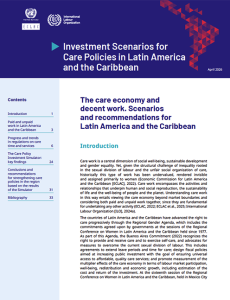
The care economy and decent work: Scenarios and recommendations for Latin America and the Caribbean | Investment Scenarios for Care Policies in Latin America and the Caribbean
The present document analyses progress and challenges in care policies in Latin America and the Caribbean, identifying factors that are crucial for effective access of all people with respect to time to care, as well as care services, benefits and entitlements.… -
 1 Dec 2025 | Publicación CEPAL
The Care Society: Governance, Political Economy and Social Dialogue for a Transformation with Gender Equality. Executive summary
This document examines scenarios for achieving the care society and proposes how to effect this change, with assessments and recommendations that underscore governance, political economy and social dialogue, along with cultural change, measurement and financing, as key elements to bring about vital transformations for sustainable development with gender equality.…
